

Transferring shares in a UK company is a normal part of business life. Whether you’re onboarding a new business partner, buying out a departing shareholder, or tidying up your cap table, handling the paperwork correctly is core to running a compliant company.
But once the stock transfer form is signed, where does it actually go? Companies House? HMRC? Both? Neither? It’s a surprisingly common point of confusion – not helped by the fact that the old paper-based system was replaced in 2020.
Read on to learn exactly what to do with stock transfer forms, when Stamp Duty applies, and what you need to update internally once you complete the transfer.
Key takeaways
- You don’t send stock transfer forms to Companies House – share transfers are reflected through your next annual confirmation statement, while changes to the company’s share structure may need separate filings.
- HMRC only needs the form when Stamp Duty is payable, or you’re claiming a relief – charged at 0.5% of chargeable consideration over £1,000 (rounded up to the nearest £5) and due within 30 days of signing.
- You can use form J30 for fully paid shares and form J10 for unpaid or partly paid shares – and keep the form with your company’s statutory registers, whether it goes to HMRC or not.
What is a stock transfer form?
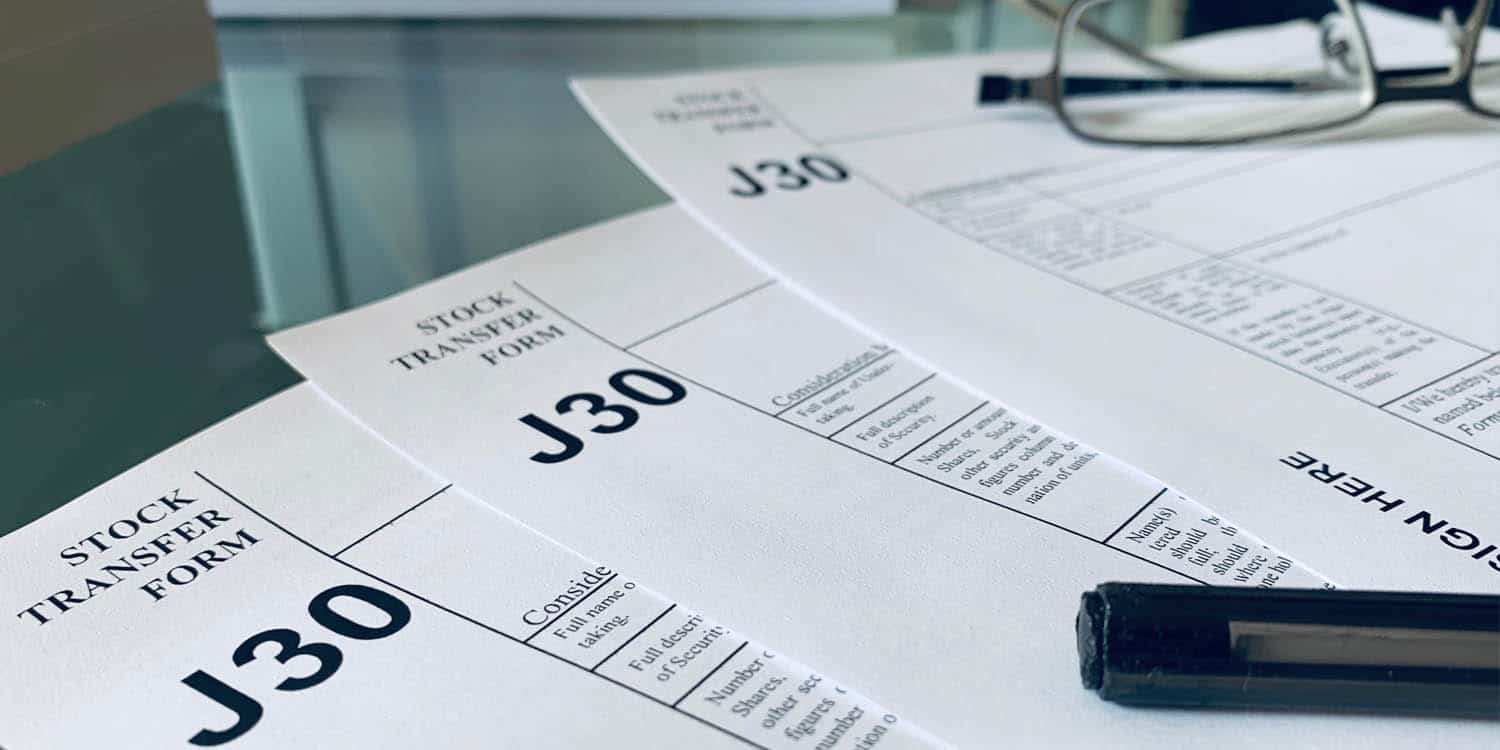
A stock transfer form is the standard paper document used to transfer legal title to shares in a UK company limited by shares. It records the key details of the transfer – who’s handing over the shares, who’s receiving them, how many shares, the share class, and the price paid (the “consideration”).
There are two versions of the form:
- Form J30 – used to transfer fully paid shares. This is by far the most common form.
- Form J10 – used to transfer partly paid shares or shares that are unpaid.
Once signed and dated, the form becomes the legal instrument of transfer. What happens next depends on whether Stamp Duty is payable and whether any specific exemption or relief applies.
Do you need to notify Companies House of share transfers?
Yes, Companies House needs to be updated on transfers. However, you don’t file the stock transfer form with Companies House, and there’s no separate Companies House form for a share transfer, unlike new share issues, which use form SH01.
Instead, Companies House is updated through the shareholder information section of your next annual confirmation statement. Between filings, the official local record of share ownership is kept in your register of members, at your registered office or a SAIL address.
If the transfer is part of a wider set of transactions that also changes the company’s share structure – for example, a buy-back, a share consolidation, or the creation of a new share class – separate Companies House filings may be required. These will have their own filing deadlines, often within 21 days or one month. A straightforward transfer of existing fully paid shares between shareholders generally doesn’t trigger these.


Completing the share transfer
A signed stock transfer form doesn’t transfer ownership on its own. The transferor remains the legal holder until the company’s directors approve the transfer and the transferee’s name is entered in the register of members – that’s when legal title passes.
Before approving, the directors should check the company’s articles of association and any shareholders’ agreement for restrictions such as pre-emption rights or director approval clauses. If the transfer is approved, the company cancels the old share certificate and issues a new one to the transferee within two months. If the directors refuse, they must notify the transferee within 2 months, stating the reasons for their refusal.
Once an ordinary share transfer is complete, you should:
- Cancel the transferor’s share certificate and issue a new one to the transferee within two months of the transfer being lodged with the company
- File copies of the stock transfer form and any company resolutions with your statutory records
- Confirm the changes in shareholdings on your next confirmation statement
- Update the PSC register if the transfer changes who has significant control over the company, and notify Companies House within 14 days
Do you need to inform HMRC and pay Stamp Duty?
Whether HMRC needs to see your form depends entirely on the nature of the transfer. There are three common scenarios.
1. Consideration of £1,000 or less
If the chargeable consideration (HMRC’s term for anything of value the buyer gives in return for the shares – cash, other shares, debt taken on, or non-cash assets) is £1,000 or less, and the transfer isn’t part of a linked series exceeding £1,000, you should complete and sign Certificate 1 on the reverse of the form – there’s no need to pay Stamp Duty or notify HMRC.
If no consideration is given at all (a pure gift), you usually don’t need to complete either certificate or send the form to HMRC.
2. Transfer otherwise exempt from Stamp Duty
Some transfers may qualify for specific Stamp Duty exemptions – for example, shares left to someone under a will, transfers between spouses or civil partners on marriage or entry into a civil partnership, or transfers to charities meeting certain conditions.
In these cases, you complete and sign Certificate 2 on the reverse of the form and keep it internally. Exempt transfers don’t need to be sent to HMRC.
Reliefs work differently. If you’re claiming a specific Stamp Duty relief (rather than a standard exemption), you leave both certificates blank and email the form to HMRC with your relief claim – even if the relief means there’s no duty payable. HMRC’s reliefs and exemptions guidance sets out the full list.
3. Chargeable consideration over £1,000
When the chargeable consideration exceeds £1,000 and no exemption applies, the transferee (the buyer) must pay Stamp Duty.
HMRC Stamp Duty is charged at 0.5% of the chargeable consideration, rounded up to the nearest £5.
For example, shares sold for £12,340 would attract Stamp Duty of £61.70, rounded up to £65.
Bear in mind that chargeable consideration means “money or money’s worth”. If part of the deal involves the buyer taking on debt, receiving non-cash assets, or providing services, that value counts too.
Under-declaring the chargeable consideration leads to underpaid Stamp Duty, which HMRC can pursue with penalties and interest.
- How to remove a shareholder from a limited company
- Can I sell shares in a private limited company?
- Understanding limited company shares
Where do stock transfer forms go?
The quickest way to understand the process is to separate Companies House, HMRC, and your own company records.
In most cases, you keep the signed stock transfer form with your company records, update Companies House via your confirmation statement, and send the form to HMRC only if Stamp Duty is payable or you are claiming a relief.
| Situation | Do you send the stock transfer form? | What do you do? |
|---|---|---|
| Ordinary share transfer (i.e. no stamp duty or relief claimed) | No. | Keep the signed form with your company records, update your register of members, and reflect the change in your next confirmation statement |
| Share transfer, but part of a wider transaction that changes the company’s share structure | Not the stock transfer form itself | Check whether separate Companies House filings are required, for example, for a buy-back, share consolidation, or new share class |
| Stamp Duty payable | Yes – to HMRC | Email the signed form to HMRC and make sure both the form and payment reach HMRC within 30 days of signing |
| Relief claimed | Yes – to HMRC | Email the signed form to HMRC with the relief claim, even if no duty is ultimately payable |
| Exempt transfer | No | Complete Certificate 2, where applicable, and keep the form with your company records |
| Chargeable consideration of £1,000 or less | No | Complete Certificate 1, provided the transfer is not part of a linked series exceeding £1,000 |
| Pure gift with no consideration | Usually no | Keep the signed form with your company records; you do not usually need to complete either certificate or send the form to HMRC |
How to submit the form to HMRC
Since 25 March 2020, the old process of posting forms to HMRC’s Birmingham stamp office has been permanently withdrawn. The process for share transfers that trigger Stamp Duty is now primarily electronic. However, if you cannot use email, HMRC does still allow you to post the form. You should not post original documents, and HMRC will not physically stamp or return the form.
You need to:
- Pay the Stamp Duty first, by Faster Payment, BACS, or CHAPS. HMRC no longer accepts cheques for this purpose.
- Use a clear payment reference – usually your name followed by the amount, with no spaces (for example, JSmith/65.00).
- Email a scanned PDF of the completed, signed, and dated stock transfer form to stampdutymailbox@hmrc.gov.uk, along with the details of your payment.
The form and payment must reach HMRC within 30 days of the date the transfer is signed. Missing this deadline may trigger penalties and interest.
HMRC accepts electronic signatures on stock transfer forms – this became permanent following the 2020 changes, so there’s no need for wet-ink originals.
What happens after HMRC processes your form
HMRC no longer physically stamps forms. Once your payment and form have been processed, you’ll receive a confirmation letter by email.
Where HMRC stamping is required, the company shouldn’t register the transfer in its register of members until it has evidence that the instrument has been duly stamped – HMRC’s confirmation letter provides that evidence under the current process.
HMRC aims to deal with 80% of forms within 15 working days and advises you to allow 20 working days overall. When the confirmation letter arrives, keep it filed with the stock transfer form and your statutory registers, then issue the new share certificate and update your register of members.


How to complete a stock transfer form
The front of the form records the core details of the transfer:
- The full name of the company and the share class being transferred (for example, “Ordinary shares of £1.00 each”)
- The number of shares, written in both words and figures
- The consideration paid
- The full name and address of the transferor (seller) and transferee (buyer)
- The signature and date of the transferor (in the case of the form J10, the signature of the transferee is also required)
The reverse of the form has the two certificates described above. You complete one of them depending on your scenario:
- Certificate 1 – for chargeable consideration of £1,000 or less, provided the transfer isn’t part of a larger linked series over £1,000
- Certificate 2 – for otherwise exempt transfers or where the consideration isn’t chargeable
- No certificate usually needed – where no consideration is given at all
If neither applies (that is, Stamp Duty is payable at the standard rate), you leave both certificates blank and send the form to HMRC for stamping. If you’re claiming a specific relief, you also leave both blank and email the form with your relief claim.
Restrictions on transferring shares
Before any shares change hands, directors should check two key documents: the company’s articles of association and, if you have one, the shareholders’ agreement. Both can contain restrictions on when, how, and to whom shares may be transferred.
Common restrictions include:
- Pre-emption rights – existing shareholders have a right of first refusal before shares can be sold to anyone outside the company. Unlike pre-emption rights on new share issues, there are no automatic pre-emption rights set out in law. So, these will normally only apply if they are found in the articles or the shareholders’ agreement.
- Director approval – many private companies give directors the power to refuse registration of a transfer at their discretion.
- Share class restrictions – specific rules may apply, for example, by limiting who can receive them.
- Compulsory transfer provisions – clauses that force a shareholder to offer their shares back in certain circumstances, such as leaving the business, death, or insolvency.
Skipping this check is one of the most common – and most expensive – mistakes in a share transfer. If the transfer breaches your articles, it may be invalid, even if HMRC has stamped the form and the register has been updated.
Common mistakes to avoid when transferring shares
A handful of problems often occur with stock transfer forms. Watch out for these:
- Completing the wrong certificate – Certificate 1 is for chargeable consideration of £1,000 or less; Certificate 2 is for exempt transfers or where there is no chargeable consideration. Completing both, or the wrong one, can lead to delays and queries from HMRC.
- Missing the 30-day deadline to send your stock transfer form to HMRC – the clock starts on the date the form is signed, not the date you get around to paying Stamp Duty.
- Overlooking linked transactions – a series of related transfers that together exceed £1,000 won’t qualify for Certificate 1, even if each transfer is below the threshold.
- Forgetting to update the register of members – the transfer isn’t legally effective internally until this is done, and missed updates are the single biggest source of cap-table drift during due diligence.
- Failing to check the articles first – pre-emption rights, director consent, and share class restrictions can all invalidate a transfer that looks administratively perfect.
- Mishandling share certificates – the transferor’s existing certificate must be cancelled and a new one issued to the transferee within two months. Skipping this causes confusion about who owns what.
- Paying by cheque – HMRC no longer accepts cheques for Stamp Duty on shares, so use Faster Payment, BACS, or CHAPS instead.
- Sending the original form by post – HMRC’s default is now email. Posting paper originals slows the process down, and HMRC doesn’t retain or return them.
Upcoming changes: a new single tax on share transfers
Worth keeping on your radar. HMRC has confirmed plans to replace Stamp Duty on shares and Stamp Duty Reserve Tax (SDRT) with a single, fully digital tax on share transfers. The current proposal is to introduce the new tax in 2027.
Key points from HMRC’s published response:
- The new tax will be mandatory and assessable on the purchaser.
- It will be reported and paid through an online portal, digitising the current paper-based process.
- HMRC intends to remove the £1,000 exemption threshold – meaning all chargeable transfers, however small, could become reportable.
- A new percentage-based penalty regime is proposed for late notification.
None of this is law yet, and draft legislation is still to come. But tax specialists have flagged that the simpler reporting process may come with a tougher penalty regime.
Getting into disciplined habits with your current process now – updating registers promptly, submitting forms on time, keeping evidence filed neatly – will make the transition easier when the new rules arrive.
Ready to handle your next share transfer?
Getting stock transfer forms right is part paperwork-on-the-day, part keeping your statutory records accurate over time. Treat both with the same level of care, and you’ll keep the company compliant, your cap table clean, and future investors, buyers, or auditors satisfied when they come asking.
If you’d like ongoing support with share transfers, confirmation statements, and company secretarial work, QCF’s Fully Inclusive Package has you covered. For one-off transfers, our dedicated Transfer of Shares service handles the paperwork for you – so you can focus on the deal rather than the admin.





Join The Discussion