


Have a business idea you can’t wait to launch while still in school? Here’s some great news: in the UK, you can get cracking straight away. There’s no minimum age to start trading as a sole trader, and from 16 you can act as a company director – which means the law allows you to register a limited company and run it yourself.
Plenty of young people are already running their own successful businesses – selling products online, freelancing in design or video editing, building brands from their bedrooms between homework and exams. Age isn’t a barrier like it used to be.
That said, there are rules to follow – and being under 18 does introduce some challenges surrounding banking and contracts. You’ll likely need an adult involved in parts of the process.
Read on to learn about how it all works – from registering your business to running it day-to-day.
Key takeaways
- You can own a company at any age in the UK.
- From 16, you can act as a company director – which means you can register and run a limited company yourself and own shares in that company, representing ownership.
- Talk to a parent or guardian before you start. They may need to help you with banking, contracts, and other areas where being under 18 creates restrictions.
- Directors have legal obligations, including filing annual accounts, a confirmation statement, and a Company Tax Return.
Can you set up a company while still in school?
Yes, you can. UK law doesn’t stop young people from owning or running a business. But your age can affect your role and the business structures available to you.
The two most common ways to run a business in the UK are as a sole trader or limited company. They work quite differently, and while you can always change, you need to know the difference.
- Who can be a company director?
- How to manage burnout as a startup founder
- How to start an online business in the UK (2026 guide)
Sole trader
You’d be joining over 4 million other sole traders in the UK. Being a sole trader means you’re self-employed and running a business as an individual – there’s no separate business entity involved. You and the business are the same in the eyes of the law.
Key facts about sole traders:
- No minimum age to start
- No registration with Companies House
- No formation costs – you can start whenever you’re ready
- You keep all the profits, but you’re also personally responsible for any debts the business takes on
- You are required by law to register with HMRC for Self Assessment if you earn more than £1,000 in a tax year
You can stop trading whenever you want, and if the business starts to grow and you want more structure or protection, you can convert to a limited company.
Limited company
You’d be joining the same 800,000 limited companies that are registered in the UK each year.
A limited company is a business that’s registered with Companies House as its own legal entity, separate from the people who own and run it. It can hold money, enter into contracts, and owe debts in its own name – independently of you.
The big catch here is that you’ll need to be at least 16 to act as a company director. This means if you are below this age, you won’t be able to register a company by yourself for you to own and run solely.
Key facts about limited companies:
- Minimum age of 16 to serve as a director
- Must be registered with Companies House before you can trade
- Your personal finances are separate from the company’s – if the business can’t pay what it owes, creditors claim against the company, and generally not yourself
- More admin involved – for example, you’ll need to file annual accounts, a confirmation statement, and a Company Tax Return each year
- Potentially more flexibility regarding tax, employing others, and paying yourself, among other things
How do the two compare?
Here’s a quick side-by-side of the main differences between sole traders and limited companies:
| Sole trader | Limited company | |
|---|---|---|
| Age | No minimum age | Must be at least 16 to be a director |
| Setup | Start trading immediately – no Companies House registration needed | Must be registered with Companies House before you can trade |
| Personal liability | You’re personally responsible for all business debts | The company is generally responsible for its own debts, not you. There are exceptions – for example, if you keep trading when the company clearly can’t afford to pay what it owes, or if you’ve personally guaranteed a loan, you can be held liable. |
| Tax | Income Tax and National Insurance on your profits | Corporation Tax on company profits, with directors who are also shareholders typically taking a mix of salary and dividends (which are subject to income and dividend tax, respectively). |
| Admin | Minimal – completing Self Assessment to report and pay tax is the main obligation | Annual accounts, a confirmation statement, and a Company Tax Return each year, among other legal duties and responsibilities. |
Setting up a private company limited by shares
A private company limited by shares is registered with Companies House and treated as its own legal entity – completely separate from you.
This is what most people mean when they talk about “setting up” or “forming” a company.
A limited company has several roles and responsibilities built into it. Directors manage the business, whilst shareholders own it through their shares. Other positions exist as well, depending on how the company is structured.
For example, if you meet certain conditions – such as holding more than 25% of shares or voting rights – you’re automatically classed as a person with significant control (PSC) and must be registered with Companies House for transparency.
Your age affects which of these roles you can take on yourself, so it’s worth understanding each one before you get started.
Minimum age for company director
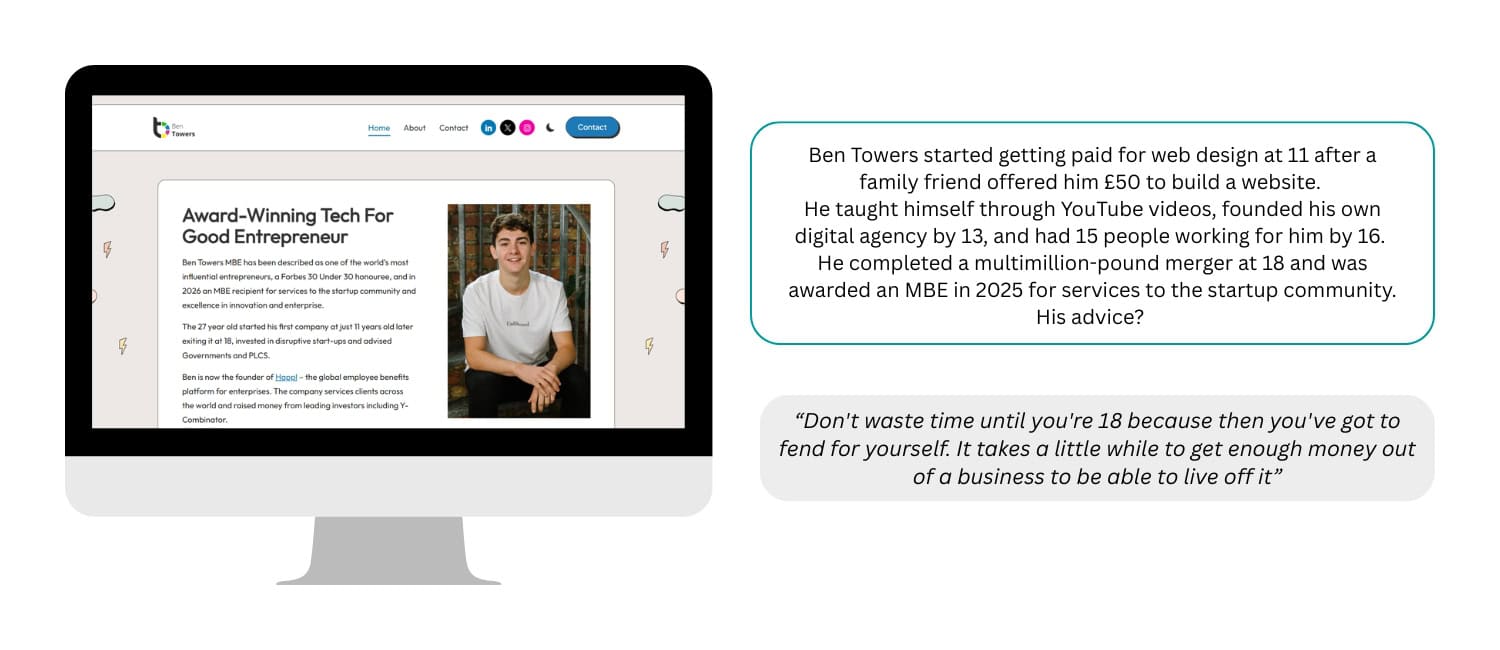
A company director is the person legally responsible for managing a company and making decisions on its behalf. Under the Companies Act 2006, the minimum age to be a company director in the UK is 16.
If you’re 16 or 17, you can appoint yourself as a director and take on the role directly. Every company needs at least one director who is a natural person (not another company), and that person can be you.
If you’re under 16, an underage company director isn’t permitted under UK law. You can still own shares in a company under the age of 16, but you can’t act as a director.
What directors are responsible for
Directors are responsible for the day-to-day running of the company. This comes with legal responsibilities that apply from day one, regardless of your age or experience. Examples include:
- Acting in the company’s best interests at all times
- Exercising reasonable care and skill in every decision
- Avoiding conflicts of interest between personal affairs and the company
- Filing annual accounts with Companies House – a financial summary of the company’s income, expenses, assets, and liabilities
- Filing a confirmation statement – a yearly update confirming that the company’s details on the Companies House register (directors, registered address, shareholders) are still correct
- Filing a Company Tax Return with HMRC – a report showing the company’s taxable profits and how much Corporation Tax is owed
- Keeping proper records of all transactions and decisions
- Ensuring the company complies with all laws and regulations
Failing to meet any of these requirements can result in penalties for the director. This includes things such as fines, but in more serious cases, a court can disqualify a director for up to 15 years. And if the company trades while insolvent, directors can be held personally liable for the company’s debts.
Bringing in an adult as co-director
Even if you’re 16 or 17 and can legally serve as a director, it’s worth considering the advantages of bringing on a trusted adult as a co-director.
Many banks, suppliers, and platforms require someone aged 18 or over to sign contracts and open accounts, and having an adult alongside you makes that much easier to manage.
If a parent or guardian agrees to step in, they take on the full set of director duties listed above. They’re just as accountable as you. It’s a legal role, and both of you need to go in with a clear understanding of what it involves.


Shareholders
A shareholder is someone who owns shares in a company, and those shares represent ownership. If you own all the shares, you own the entire business.
Company law doesn’t set a minimum age for holding shares. You can be a shareholder at any age, which means you can own a company even if you’re too young to be its director.
There’s a catch, though. Because you’re under 18, contracts you sign – including the agreement to subscribe for shares – can be challenged or voided. To keep things more watertight, a parent or guardian can hold the shares on your behalf (known as holding “on trust”) until you turn 18, at which point they transfer across to you.
People with significant control (PSCs)
Every UK company has to identify and register its people with significant control. A PSC is someone who holds ultimate control over the company. You’ll typically qualify if you:
- Own more than 25% of the company’s shares
- Hold more than 25% of the voting rights
- Have the right to appoint or remove the majority of directors
If you’re the sole shareholder, you’ll automatically be the PSC and will need to be registered with Companies House. There are no age restrictions on being a person with significant control, as it is more a statement of fact rather than position.
Contracts, banking, and practical considerations
Registering is easy, but being under 18 brings challenges like banking and signing contracts – areas where an adult can help.
Contracts
Until you turn 18, contracts you sign may not be legally binding. In England and Wales, minors can generally walk away from contracts that aren’t for “necessaries” – meaning essential goods and services. That’s why some suppliers, clients, and platforms won’t deal directly with someone under 18.
For anything involving regular payments or long-term commitments, a parent or guardian will need to be involved, for example by signing as a co-director of your company.
Banking
If you’re running a limited company, you’ll need a dedicated business bank account. Most UK banks require all directors and account signatories to be at least 18, which can make this trickier than you’d expect.
Some digital banks may have more flexible age requirements, but terms vary – read them carefully before signing up.
This is a big reason why forming a company with an adult co-director can be a smart decision for under-18s. If you’re thinking about going down that route, speak to the bank directly to confirm their policies and understand what being an account signatory actually involves for the adult.
If you’re a sole trader, you don’t necessarily need a separate business bank account. Some sole traders use a personal account for business income, though keeping business and personal money apart from the start makes everything easier to manage.
How to register your company
If you’ve decided that a limited company is the way to go, here’s what the registration process looks like. If you have all the information needed to hand, the online application typically takes around 15 to 30 minutes.
You can register directly with Companies House or through a company formation service like QCF. Both produce the same outcome – a registered private company limited by shares. The difference is the level of support you get alongside the registration.
A company formation service handles the application on your behalf and typically offers packages with extras like a registered office address, company secretary support, and help opening a business bank account.
Choosing a company name
You can pick whatever name you like for your company, as long as it follows a few rules:
- It must end with ‘Limited’ or ‘Ltd’ (or the Welsh equivalents ‘Cyfyngedig’ or ‘Cyf’)
- It must be unique on the Companies House register
- It can’t be considered the ‘same as’ or ‘too like’ another registered name
- It must not be offensive
- It must not contain sensitive words or expressions without written approval from the relevant body
The ‘same as’ and ‘too like’ rules trip people up more than you’d expect. Swapping letters for symbols (Ex@mple vs Example) counts as the same name. Minor wording tweaks (This Iz A Company vs This Is A Co) can be considered too similar.
SIC codes
When you register, you’ll need to select one to four SIC codes to describe what your business does. SIC stands for Standard Industrial Classification, and the codes are five-digit numbers from a list maintained by Companies House.
There are hundreds of codes to choose from. Some of them are quite general whilst others are surprisingly specific – so you should be able to find at least one that fits. You’re not locked in either. If your business changes over time, you can update your SIC codes when you file your annual confirmation statement.
Registered office address and email
Every limited company needs a registered office address. This is the official address where, amongst other things, Companies House, HMRC, and other bodies send correspondence for the company.
It must be based in the UK, can’t be a PO box, and you need the property owner’s permission to use it. Any post that is delivered here must come to the attention of a person acting in behalf of your company. The address appears on the Companies House public register, meaning anyone can look it up online.
Using a home address is allowed, but it’s worth thinking twice about it for that reason. A registered office address doesn’t have to be where you work – it just needs to be a UK address where you can receive official mail.
Several QCF formation packages include a Registered Office Address Service, which lets you use our London address instead of your own. You’ll also need a registered email address for official correspondence. Unlike the office address, this doesn’t appear on the public register.
Director and shareholder details
For each director, you’ll need to provide:
- Full name and title
- Date of birth – remember, directors must be at least 16
- Nationality
- A service address – this appears on the public register
- A residential address – this stays private unless it’s also being used as the service address
For each shareholder, you’ll need similar personal details.
Share details
For each shareholder, you’ll also need to provide:
- Number of shares held
- Currency
- Price per share
- Class of shares – Ordinary shares are the default for most new companies
How you allocate shares defines ownership. If you’re the sole shareholder, you own 100% of the company, whether you hold one share or a thousand.
Review and submit
Once everything is filled in, review it carefully and submit. If you’re using a QCF formation package, the team will review your application before sending it on to Companies House.
Once your company is registered, you’ll receive digital copies of your certificate of incorporation and memorandum and articles of association.


What to do after your company is formed
Once your company is on the register, there’s some important groundwork to lay early on, including:
- Register for Corporation Tax with HMRC within three months of starting to trade
- Open a business bank account
- Start keeping records from day one – track every pound in and every pound out
- Know your filing deadlines – annual accounts, the confirmation statement, and your Company Tax Return each have due dates. Miss them and you’ll face personal fines as a director
- Get professional support if you need it – an accountant can help with tax, and a company secretary service can take care of your Companies House filings
Getting on top of this early saves you a lot of stress further down the line.
Don’t be afraid to ask for help
Starting a company while in school is exciting, but it comes with financial and legal responsibilities that deserve a proper conversation before you commit. So before you jump in, sit down with a parent, guardian, teacher, or other trusted adult to talk things through.
Don’t underestimate the value of reaching out to local business owners or entrepreneurs you look up to, either. You’d be surprised how many are happy to share what they’ve learned, and some may even offer to mentor you informally.
There are also programmes and organisations designed specifically to support young founders:
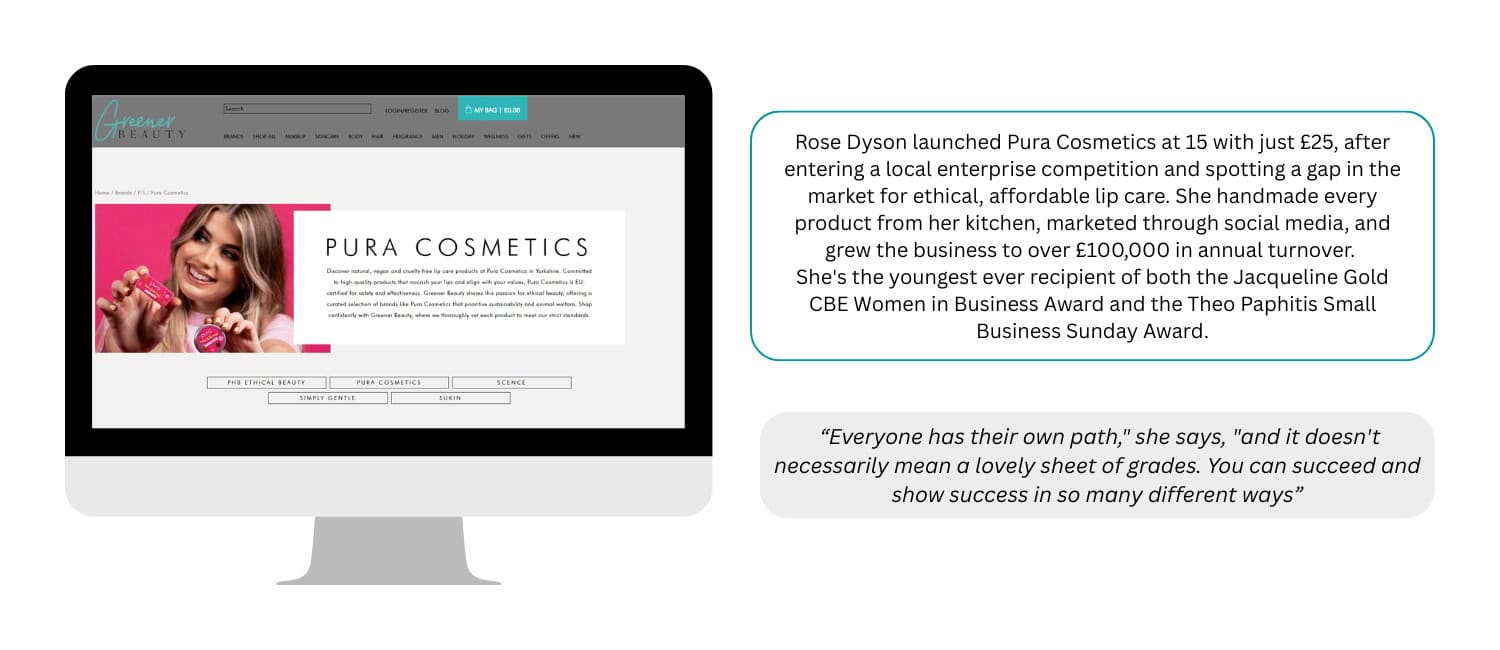
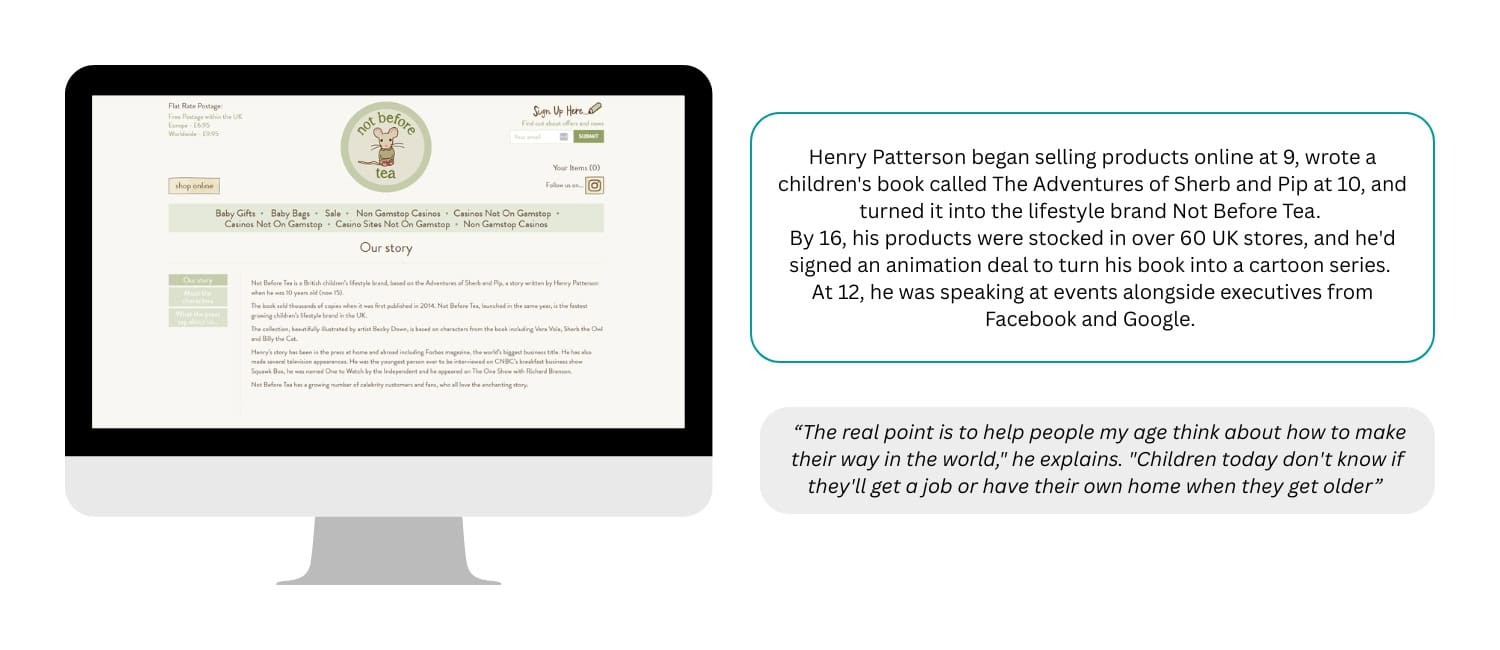
- Young Enterprise – runs the 10x Challenge for 11 to 19-year-olds, giving you £10 and four weeks to build a business from scratch
- The King’s Trust – offers workshops, mentoring, and access to funding for 16 to 30-year-olds
- Innovate UK Young Innovators – provides funding and mentoring, particularly for ideas in sustainability, tech, and social impact
- Ultra Education – runs entrepreneurship clubs and workshops for 7 to 18-year-olds

Many schools and colleges also run their own enterprise programmes – business plan competitions, mentoring from local business owners, and startup grants. It’s worth checking what’s available wherever you live.
Ready to get started?
Starting a company while in school is more straightforward than you might think.
Whether you begin as a sole trader to test your idea or go straight to registering a limited company, the important thing is to understand the rules around your age and make sure you’ve got the right support around you.
Excited to kickstart your entrepreneurial journey? Remember, at Quality Company Formations, we can support you by taking care of Companies House registration, so you can focus on building the business. Whatever happens next, you’ll walk away knowing more about how money, customers, and decision-making work than most people pick up in years.





Join The Discussion