
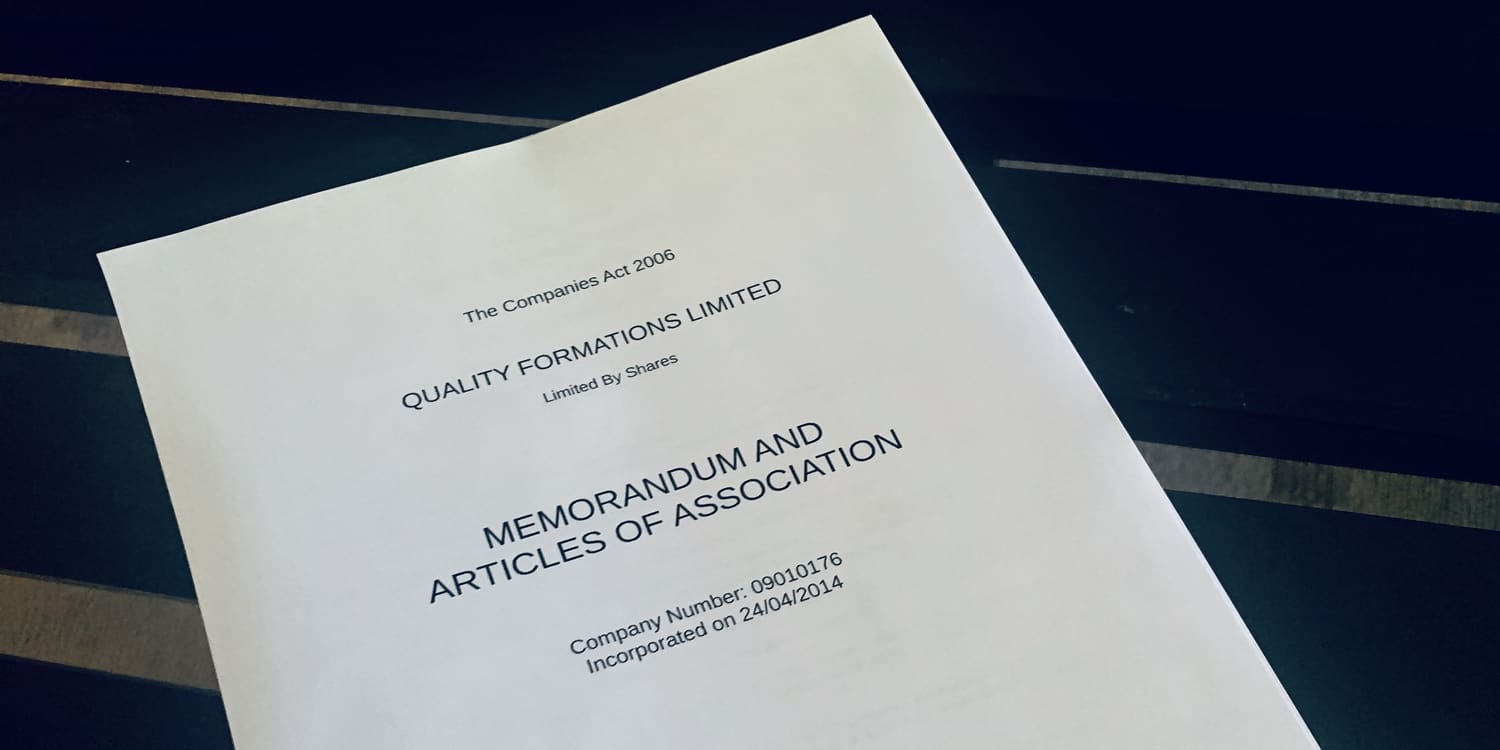

Updating your company’s articles of association might sound technical, but the process is usually quite straightforward once you understand the basics. In simple terms, you’ll need approval from your shareholders (at least 75% of the votes must be cast in favour), and then you must file the updated documents with Companies House within 15 days.
Your articles of association are the key rulebook for how your company is run. They set out how decisions are made, how shares work, and the responsibilities of directors.
While many businesses stick with the standard Model Articles when they start, these don’t always suit a growing or changing company. The good news is you can update them whenever you need to, so long as you follow the correct process.
Key takeaways
- Amend your articles of association with a special resolution to adapt to your company’s evolving needs and legal changes.
- Regularly review your articles to ensure they protect shareholders’ rights and align with your company’s governance structure.
- Consider bespoke articles for tailored provisions, such as multiple share classes or enhanced shareholder protections.
Reasons to amend your articles of association
There are many reasons why you may want to amend your company’s articles of association, and sometimes you may be forced to make changes by new legislation.
These are a few reasons why you might adapt the Model Articles, of which we have listed 3 examples below.
Shareholder transfers
Companies with more than one shareholder may choose to amend the articles to control the way shares are transferred from one shareholder to another. This can protect you as a founder by giving you more of a say about the people who are a part of your company.
You may want to amend the articles to restrict share transfers or to include compulsory transfer clauses. Similarly, it can be helpful to have drag-along rights and tag-along rights to make all shareholders aligned when it comes to the sale of the company.
Introducing multiple share classes
Under the Model Articles, the default position is that all shares are ‘ordinary’ shares, and the Model Articles aren’t generally suitable for companies that want more than one share class.
This can be a problem when you have shareholders with different roles in the business. Some shareholders may have very little involvement with the business, whereas other shareholders (who are also directors) might be involved in the day-to-day running of the business. So, you may want some shareholders to have shares with no decision-making powers.


You may also want to be able to issue preferential shares to certain investors, so that they see a return on their investment quickly.
Different classes of shares carry different rights. Preferential shares give preferential treatment on dividends. Other classes provide enhanced voting powers, such as weighted votes or veto powers.
By way of illustration, you might end up with:
- Investor shares with limited voting rights
- Shares with priority dividends
- Shares with extra voting power for founders
Growing businesses often need this level of flexibility and adaptability. Amending the articles of association can help make this happen.
Provisions for a sole director
The Model Articles state that a minimum of two directors is required for decision-making. If you’re the only director in the business, this can create uncertainty.
For a belt and braces approach, it’s often best to amend the Model Articles to make clear that a single director makes decisions on behalf of the company.
Steps to approve changes through a special resolution
You can amend a company’s articles of association by passing a special resolution of the members.
This type of resolution requires a majority of at least 75% of the total votes, and it can be passed either (i) as a written resolution that is signed by the shareholders, or (ii) by casting votes at a general meeting of the shareholders.
Written resolutions for amendments
A written resolution is often the quickest and most convenient option for smaller companies because there is no need to arrange and attend a general meeting, which can be time-consuming.
Each member will simply be provided with a copy of the updated articles to review and the written resolution itself. If they are happy with the changes, they will provide their approval by signing the resolution.
- How to transfer company shares
- What is a company resolution? Types & requirements explained
- Difference between board resolutions and board minutes
A copy of the special resolution should be delivered to Companies House within 15 calendar days of being passed, together with a copy of the new articles of association.
General meetings and special resolutions
When a written resolution is unsuitable, which is often the case when companies have large memberships, you can amend a company’s articles of association by passing a special resolution at a general meeting. It is also possible for shareholders to propose the amendment themselves, although usually it is the directors that propose it.
There are several steps required to pass a special resolution at a general meeting:
1. Hold a board meeting
First, hold a board meeting to discuss the reasons for the change, and to agree the wording of the proposed changes to the articles. You should also agree the wording of the proposed resolution.
As always, keep careful minutes of this meeting so you have a robust paper trail of the decisions that were made and why.
Note that you can also agree to propose the change through written resolution of the directors.
2. Seek approval from the members
The directors send notice of the meeting to all members at least 14 clear calendar days in advance, stating the time, date, place, and purpose of the meeting.
The members attend the general meeting, discuss the proposed changes and the resolution, and provide their votes by way of a poll or show of hands.


If a majority of at least 75% of votes are cast in favour of the proposed changes, the resolution is passed. In some cases, you may also need shareholder class consent.
As mentioned above, it is also possible for the members to approve the resolution by written resolution, removing the need to hold a meeting.
3. File the special resolution and new articles with Companies House
The directors send a certified copy of the special resolution to Companies House, accompanied by a copy of the amended articles, within 15 calendar days of the date of the resolution passing.
4. Maintain records internally
Copies of the amended articles and special resolution should be sent to every director and the company auditor (if you have one).
The company must also retain minutes of the meeting that passed the resolution, and a copy of the resolution.
Best practices for maintaining current articles of association
Your articles of association shouldn’t just sit untouched after you set up your business. Keeping them up to date can help you avoid disputes, attract investors, and run your company more smoothly.
Treat your articles as a living document that grows with your business, not just a legal formality. Before you make any changes to your articles, we recommend seeking professional legal advice from a specialist business solicitor.
For comprehensive guidance on maintaining legally compliant company documentation, please visit the Quality Company Formations blog. Alternatively, if you want to create your own resolution for shareholders relating to the adoption of articles of association, you can access a template as part of Quality Company Formation‘s Business Document Template Library.





Join The Discussion
Comments (14)
Hi
I have been asked to join a board of directors for a development. The Memorandum of Articles needs to have some wording changed in order for this to happen. All directors have voted me in already, but to make this official, are they ok to just hold a meeting to pass a Special Resolution and then send the signed version to Companies House?
Dear Carly,
Thank you for your kind comment.
If the current articles do not allow for you to be appointed as a director, these would first need to be amended before the appointment can take place. To adopt a new set of articles, this is typically a matter for the members of company to decided on, usually by passing a special resolution.
Kind regards,
The QCF Team
I am looking for urgent guidance, I am a fellow director of CIC company and we are looking to amend its aims and objectives. There are 2 directors including myself. We set the CIC as a social enterprise back in 2021 but our mission since that time has changed, what are the steps in making the amendments for a CIC company?
Thank you in advance.
Hi Harry,
Thanks for your message.
There are 2 things you need to do in order to change the objectives of a Community Interest Company.
1. Complete the form CIC34 detailing your new activities, together with how they benefit the local community
2. Amend your articles of association to detail the new objects by having your members (shareholders or guarantors) pass a special resolution (note that at least 75% of the eligible votes need to be cast in favour of the resolution for it to pass).
Send a copy of your complete form CIC34, together with the new articles and the accompanying special resolution to the CIC Regulator. The Regulator will need to approve the change to your objects.
We hope this helps!
Kind regards,
The QCF Team
Hi
The lease to the 4 flats in our building contain a single clause referring to repairing obligations . The freeholder who is the four owners disagree with one another as to the correct interpretation of this clause. This is because , as one director of the Ltd company , one individual is requiring the 3 others to share payment for replacing the widow frames of his recently acquired apartment . Historically we have repaired our own . This individual director has now stopped paying all contributing bills eg buildings insurance fire alarm maintenance
Can we 3 directors amend the articles of association by vote to clarify the obligation set out in the lease please ?
G Berryman – Smart
Thank you for your kind enquiry, Georgina.
You mentioned that the three directors of the company wish to amend the company’s articles of association in order to clarify the obligation concerning repairs. It should be noted that the articles of association can only be amended by special resolution of the members (that is, 75% or more of the votes cast in favour of the change by the members of the company) unless of course those particular articles are entrenched or there are other restrictions on making adjustments in place. The directors, in their position alone, do not have the ability to make changes to the company’s articles of association.
We trust this information is of use to you.
Kind regards,
The QCF Team
Hi, we have Articles of Association for a company limited by guarantee which were written under the Companies Act 1948. It is legally required to update them to reflect the Companies Act 2006, even if the provisions in the original remain fit for purpose?
Many thanks
Thank you for your kind enquiry, Rosa.
It is not legally required to update your articles of association to reflect the Companies Act 2006; however, it is recommended to update your articles to bring them into line with the latest Companies Act. This would particularly be the case if the articles of associate for your company were written under the Companies Act 1948, as this would mean a few acts would have passed since their last update.
We may be able to assist you should you wish to adopt new articles of association. If you want us to take a look and potentially quote for this work, please give our Company Secretarial Team a call on 020 3984 5389.
We trust this information is of use to you.
Kind regards,
The QCF Team
Thanks for finally writing about How to amend a company’s articles of
association
Thanks for your comment, Lyle.
We’re glad you found this blog article of use.
Kind regards,
The QCF Team
We are about to take over from the developer but in the current articles they have 75% of the voting rights, is it possible to get this removed?
Thank you for the question.
Can you clarify the shareholding structure of the company, please? For example, does the individual have 75% votes due to having 75% of the shares. Or are there multiple classes with different voting rights? Also, has the developer agreed to transfer shares?
Kind regards,
The QCF Team
Hi,
I want to amend the articles of association of a company limited by guarantee. Can you assist me? What is the fee?
Thanks for your question Muhammad.
We may be able to help but we’ll need a little more information. Can you provide more details about the changes that are required?
If you’d rather not post this here, feel free to send it over to info@qualityformations.co.uk.
We look forward to hearing from you.
Regards,
The QCF Team